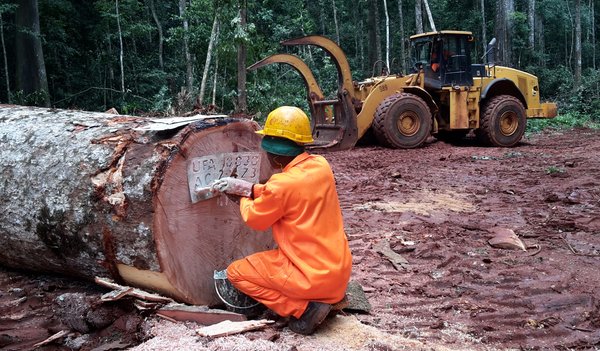
Technical assistance in forest governance

EticWood doesn't just deliver reports. We work alongside your teams, designing training programs, building tools, mentoring staff, and supporting implementation from day one. The goal is always the same: your organization becomes more capable, not more dependent.
Forest governance has grown significantly more complex. Regulations such as the EUDR (EU Deforestation Regulation) and the FLEGT (Forest Law Enforcement, Governance and Trade) framework demand traceability systems, legal verification, and documented due diligence. Most organizations face real capacity gaps when implementing these requirements.
The challenges are structural. Regulatory frameworks evolve faster than institutional capacity. Community engagement requires specific facilitation skills. Illegal logging prevention demands field-level monitoring tools that take time to build. Technical assistance in forest governance exists precisely to bridge these gaps, providing the right support at the right moment, without replacing local expertise.
EticWood has observed these dynamics across West and Central Africa, Central America, and Southeast Asia. The organizations that progress fastest are those that combine their own knowledge with targeted external support.
EticWood's technical support covers the full implementation cycle. Depending on your needs, this includes:
Hands-on training : workshops, field schools, and stakeholder training programs adapted to your context.
Capacity building programs : structured, multi-month engagements that build lasting institutional knowledge.
Implementation support : working alongside your team to deploy traceability systems, monitoring tools, and compliance procedures.
Tool and resource development : building practical guides, legal matrices, and digital systems your organization owns and operates.
Mentoring and technical guidance : ongoing coaching for staff navigating complex regulatory or operational environments.
The outcomes are measurable and lasting:
Your teams gain skills they apply independently, long after the program ends.
EUDR, FLEGT, and national forest law requirements become manageable, not overwhelming.
Demonstrated technical capacity opens doors to climate finance, bilateral grants, and cost-share programs.
Illegal logging prevention
Field-level monitoring systems and traceability tools protect your forest resources.
Facilitation skills and participatory approaches improve relationships with local populations.
EticWood operates as Technical Operator of the EU FLEGT VPA program, a 5-year initiative covering 8 partner countries, supervised by the AFD (Agence Française de Développement). Since 2022, this has meant managing 44 projects across Honduras, Ghana, Congo, Guyana, and Liberia, with 16 currently active.
That scale of operational responsibility shapes how EticWood approaches technical assistance. A few concrete differences:
Technical assistance is about empowerment. EticWood builds on what your organization already knows, we don't replace local expertise, we reinforce it. Programs are designed from the start to transfer knowledge, tools, and confidence to your teams. We work in French, English, Spanish, and Portuguese, across diverse institutional contexts: governments, NGOs, communities, and private landowners.












Forestry professionals, civil society organizations, NGOs, local and regional government staff, indigenous peoples' organizations, private landowners, and forest cooperatives. Any organization implementing or overseeing forest governance that needs practical support, training, or capacity building.
Consulting delivers recommendations. Technical assistance implements them. EticWood works alongside your team: training staff, building tools together, mentoring through processes. The focus is on building your capacity, not creating dependency. Both approaches are often combined for best results.
Programs vary by need. Short engagements: 2-day workshops on monitoring or compliance. Medium-term: 6-month capacity building with monthly training and mentoring. Long-term: multi-year programs combining training, implementation, and coaching. All start with a needs assessment and end with documented procedures your team owns.
Yes. EticWood helps identify relevant funding sources, prepare applications, meet eligibility requirements, implement funded activities, and report to funders. Many programs, including EU climate finance and bilateral grants, require demonstrated technical capacity that we help you build.
EticWood works in multiple languages and partners with local facilitators for contexts where additional linguistic support is needed. Cultural and linguistic appropriateness is central to effective capacity building. We do not just translate content. We adapt our approaches to local realities, communication styles, and institutional contexts to make sure the support is genuinely accessible and useful.
The investment depends on the scope, duration, and number of participants. Many clients use grants, cost-share programs, or co-funding arrangements to cover the costs. We work with you to identify the most appropriate funding structure. The return on investment is typically significant: improved access to funding, stronger compliance, better forest management outcomes, and reduced operational risk over time.
Absolutely. EticWood provides targeted support for EUDR compliance, including training on regulatory requirements, hands-on setup of due diligence systems, geolocation data collection, documentation procedures, risk assessment methods, and supplier engagement strategies. Support is available as standalone workshops, field-based training, or ongoing technical assistance programs depending on your needs and timeline.
You keep the capabilities. That is the goal. EticWood builds sustainability into every program from the start. At the end of an engagement, your team has the tools and resources they own, documented procedures they can follow independently, trained internal trainers where appropriate, and access to follow-up support options such as check-ins and refresher sessions. We also connect you with peer networks of organizations facing similar challenges.