Forest governance consulting firm

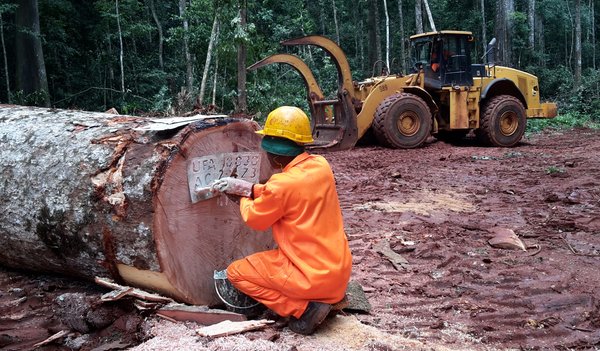
Forest governance is legally, politically, and socially complex. EticWood works with you to build systems that are traceable, defensible, and built to last. We don't impose solutions. We co-design them with the actors who will implement them.
Tropical forests are under pressure from multiple directions at once: illegal logging, land tenure conflicts, weak regulatory frameworks, and tightening international trade rules. The EU Deforestation Regulation (EUDR) and the FLEGT (Forest Law Enforcement, Governance and Trade) framework have raised the bar for what "legal" and "sustainable" actually mean in practice.
Without robust transparent governance systems, forest-producing countries risk losing market access, missing climate finance opportunities, and deepening conflicts with local communities. Forest policy and regulation is no longer a background concern. It's a prerequisite for any credible forestry operation or conservation program.
The FLEGT Voluntary Partnership Agreements (VPAs) are bilateral treaties between the EU and timber-producing countries that directly address this challenge. They establish what legally produced timber means in practice, from forest management to export. EticWood operates at the heart of this system as Technical Operator of the EU FLEGT VPA programme (2022–2027), a €17 million initiative funded by the European Union and supervised by the AFD (Agence Française de Développement), supporting 8 partner countries.
In practice, forest governance consulting covers the full chain from policy design to field implementation. EticWood works across five interconnected areas:
Policy and regulatory support : drafting legality matrices, terms of reference, and compliance frameworks aligned with EUDR and FLEGT requirements.
Timber traceability systems : deploying digital tools like the SALH system in Honduras, the SIVL (Système Intégré de Vérification de la Légalité) in Congo, and the dWTS timber tracking software in Guyana.
Independent monitoring : coordinating third-party audits via NGO consortiums (CJJ/FODER/RFUK in Congo; SDI/CS-IFM in Liberia) to ensure system integrity.
Capacity building : training government agencies, technical secretariats, and community organizations to operate governance systems independently over time.
Stakeholder engagement : facilitating multi-party committees (Joint Implementation Committees, Steering Committees) that include civil society, private sector, and government representatives.
Concrete outcomes, not just deliverables. Here's what EticWood's forest governance work produces for clients:
Accountable, transparent systems that hold up to regulatory scrutiny.
FLEGT licenses can serve as proof of due diligence for European importers, reducing compliance risk.
Governance credibility unlocks carbon markets and international funding mechanisms.
Governance systems that protect ecosystems, not just timber flows.
Participatory processes that build trust between governments, communities, and the private sector.
EticWood does not apply generic frameworks. Every project begins with a country-level diagnostic, assessing the legal context, institutional landscape and community dynamics before designing a tailored solution.
Our work is built on three principles:
Forest governance is slow, contested, and politically sensitive. It requires partners who understand both the technical architecture of legality systems and the human dynamics that determine whether those systems actually function.
EticWood brings both. Our team has designed traceability systems, facilitated multi-stakeholder committees, supported indigenous communities, and reported to the European Commission, all within the same program. That breadth of experience, grounded in real field constraints, is what we bring to every new engagement.













Policy advisory typically runs 6–12 months. Capacity building programs: 1–2 years. Full governance reform: 3–5+ years. An initial assessment usually takes 2–3 months. Timelines adapt to your context and budget.
Scope, geography, and duration determine cost. Small assessments: €15–50k. Medium programs: €100–500k. Large multi-year reforms: €1M+. EticWood offers flexible arrangements, including phased approaches and support identifying co-funding opportunities.
EticWood operates across West and Central Africa, Latin America, and beyond. Even in new geographies, we adapt our expertise to local regulatory and social contexts. An initial consultation helps determine the right fit.
Yes. EticWood scales services to fit budgets. Options include phased approaches, co-funding identification, partnerships to share costs, and focused scopes targeting priority areas only.
Participatory methods are central to our work: Free Prior Informed Consent (FPIC), co-design workshops, local facilitators, benefit-sharing plans, and capacity building for community representatives.
KPIs are set upfront and tracked jointly. Regular reviews allow early course correction. Adaptive management is built into every project. EticWood's approach is to document gaps honestly. That's what makes governance systems credible over time.