Forest Management: Principles, Practices & Expert Solutions

Forest management is the planned stewardship of forest ecosystems to sustain their health, productivity, and long-term value. It covers timber production, biodiversity conservation, watershed protection, carbon sequestration, and community livelihoods.
Forests cover over 30% of the Earth's land surface and deliver critical ecosystem services: climate regulation, freshwater supply, and habitat for millions of species. Without active, science-based management, these functions degrade rapidly under agricultural and industrial pressure. In West and Central Africa, where EticWood operates, forest loss is driven by cocoa farming, logging, and weak governance.
Sustainable Forest Management (SFM) rests on eight core principles, aligned with FAO guidelines and the UN Sustainable Development Goals (SDGs):

Long-term forest health : rotation cycles of 25 years or more ensure natural regeneration of timber species.

Biodiversity conservation : protecting High Conservation Value (HCV) zones: intact forest massifs, hydrographic areas, sacred sites.

Soil & watershed protection : riparian buffer zones and erosion controls are mandatory in any certified management plan.

Carbon stock maintenance : managed forests can sequester and store carbon while remaining economically productive.

Stakeholder participation : indigenous peoples, local communities, and workers' rights are integrated from plan design to implementation.



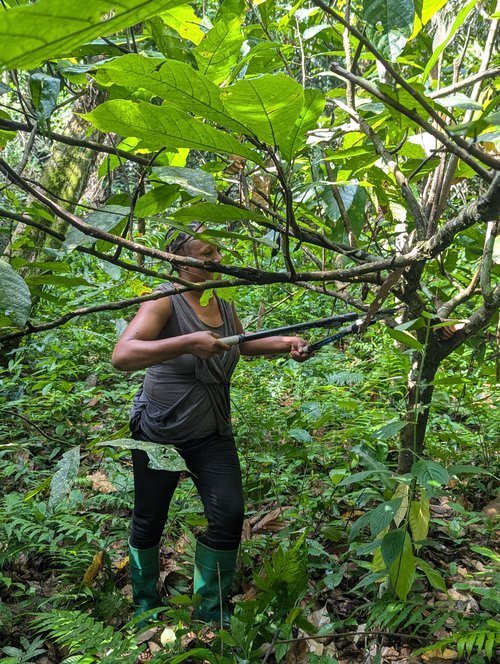
Field practices translate principles into measurable outcomes. EticWood designs and implements 25-year forest management plans for concessions covering hundreds of thousands of hectares in Central Africa.
These plans are legally required to obtain an exploitation concession and are grounded in statistical field inventories covering timber resources, fauna, and riparian communities.
Key practices include selective logging with minimum felling diameters, parcel rotation to allow natural regeneration, reforestation and afforestation (ARR: Afforestation, Reforestation, Revegetation), fire management, and pest control. Each harvested tree is assigned a unique traceability code linking the log to its stump: a procedure EticWood implements to meet legal compliance and certification requirements.
Well-managed forests are among the most cost-effective climate solutions available. They sequester CO₂, maintain carbon stocks, and reduce emissions from deforestation.
EticWood integrates climate objectives directly into management plans, combining avoided deforestation with ARR activities certified under VERRA standards, including the CCB (Climate, Community & Biodiversity) label that guarantees social and biodiversity co-benefits.
In Côte d'Ivoire, EticWood manages a conservation project covering 150 000 hectares across the Lagune and Comoé regions, designed end-to-end, from feasibility to credit issuance, via a local office in Abidjan. Climate resilience is built in through species diversification and adaptive management cycles.
Three certifications set the international benchmark for sustainable forest management:
Forest Stewardship Council: the global reference standard covering environmental, social, and economic criteria. Annual audits by Bureau Veritas, SGS, or Rainforest Alliance.
Programme for the Endorsement of Forest Certification: the European equivalent, widely recognised by buyers and investors.
Pan African Forest Certification: adapted to African contexts, increasingly relevant for concessions targeting European markets under the EUDR (EU Deforestation Regulation).
Effective forest management is multi-stakeholder by design. Forest owners, governments, local communities, indigenous peoples, NGOs, industry, and researchers all have legitimate roles. EticWood operates at the intersection of these actors, coordinating field partners such as Conservation Justice and Brain Forest, while engaging local communities as active participants, not passive beneficiaries.
In Central Africa, this means integrating customary land rights, workers' rights, and HCV zone mapping into every management plan from the outset.




























EticWood delivers end-to-end forest management consulting: from 25-year management plan design and HCV zone identification, to FSC/PEFC certification support, traceability system implementation, and carbon project development (REDD+, ARR). EticWood works with you from the first feasibility assessment through to credit issuance and beyond.
Field operations are backed by drone surveys, satellite monitoring, and GIS analysis, combined with local expertise from offices in Brussels and Abidjan. Clients include private concessions, governments, and international institutions.
Forestry is the broad discipline covering the science, practice, and economics of forests. Forest management is its applied component: creating and executing management plans, monitoring outcomes, and adapting practices. All forest management is forestry; not all forestry is management.
Yes. Even forests of 5–50 hectares benefit from tailored plans: optimised harvesting, certification access via group schemes, carbon revenue potential, and EUDR compliance. EticWood scales its approach to the client's context and objectives.
Standard plans cover 25 years for tropical concessions, with annual operating plans reviewed each year. Adaptive management means continuous monitoring and adjustments between formal reviews, not a document that sits on a shelf.
When well-designed, yes. Revenue streams include certified timber (premium pricing), carbon credits (REDD+, ARR), ecosystem service payments, and non-timber products. Certification reduces market access risk and satisfies investor ESG requirements. Sustainable management is often more profitable long-term than extractive approaches.
GIS mapping, satellite remote sensing, drone surveys, mobile data collection apps (offline-capable), carbon accounting platforms, and AI-assisted health monitoring. EticWood combines these technologies with field expertise, including partnerships with Dronec for aerial inventory and Canop for geospatial analysis.
Management plans now integrate climate projections: climate-tolerant species selection, mixed-species diversification to reduce risk, increased fire management, and drought resilience measures. Adaptive management is no longer optional, it is the standard.
La biodiversité est un objectif, pas une contrainte. Les certifications FSC et PAFC imposent la protection des zones HVC, la conservation du bois mort et la diversité structurelle. EticWood assure le suivi d'espèces menacées, dont les chimpanzés, dans le cadre de ses programmes terrain.
Une gestion proche de la nature — imitant les processus naturels, conservant les vieux peuplements, protégeant les zones riveraines — peut atteindre une valeur écologique comparable. L'approche paysagère la plus efficace combine forêts naturelles protégées, concessions durables et zones de restauration active.